10% Off Retail prices for our premium value mini excavators

How to Choose the Right Forklift Size for Your Business Needs
Finding the "right size" involves more than just physical dimensions; it requires a deep understanding of your load requirements, lift heights, and the specific environment where the machine will operate
3/4/20265 min read
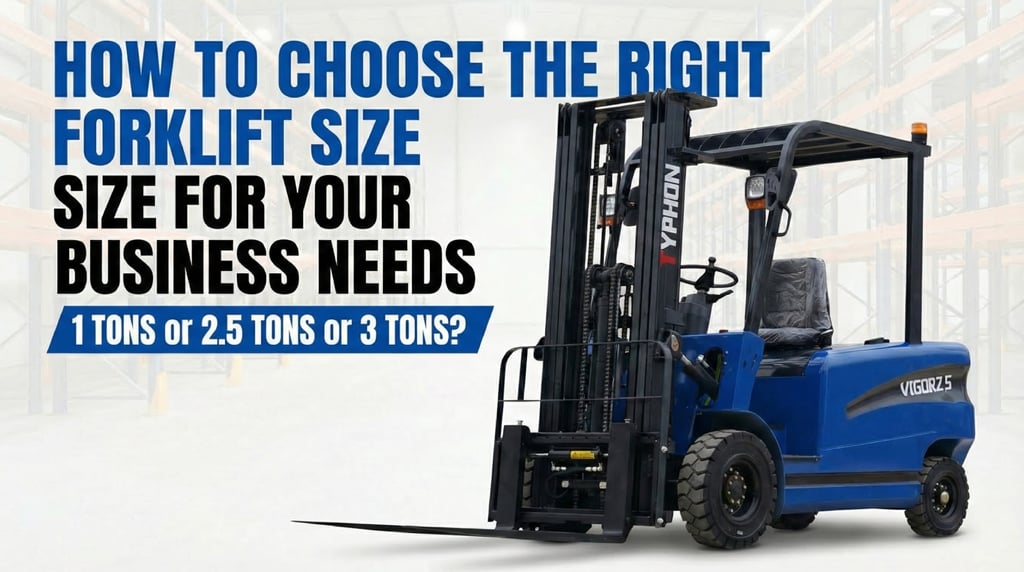
Selecting the right material handling equipment isn't as simple as picking the biggest machine your budget allows or the smallest one that fits through your warehouse doors. Proper forklift selection is a strategic decision that directly impacts your daily operations, forklift safety protocols, and overall bottom line. A forklift with an inadequate load capacity will struggle with heavy pallets, creating serious workplace hazards and bottlenecking productivity. Conversely, choosing a warehouse forklift that is too large makes maneuvering cumbersome, wasting valuable aisle space, fuel, and operational efficiency.
Finding the "right size" involves more than just physical dimensions; it requires a deep understanding of your load requirements, lift heights, and the specific environment where the machine will operate. Whether you are managing a bustling distribution center, a construction site, or a small retail backroom, the principles of selecting the correct equipment remain the same. This guide will walk you through the essential factors you need to consider to ensure your investment drives efficiency rather than hinders it.
Understanding Load Capacity and Load Center
Most forklifts are rated with a 24-inch load center. This means the weight is balanced about 24 inches from the front of the forks. But in real work, loads are not always perfect pallets. If your load is longer, uneven, or needs special attachments, the weight shifts forward. When the load center moves farther from the mast, the lifting capacity drops. For example, a 5,000 lb forklift may only safely lift around 3,500 lbs if the load is very long. Before choosing a forklift for sale, look at the average and maximum weight you handle. Also, check the size and shape of your products. Always pick a forklift with a higher capacity than your heaviest load. This gives you a safety margin and helps prevent tipping or damage.
Calculating Lift Height and Mast Requirements
Once you know how much weight you need to move, you must determine how high it needs to go. This might seem straightforward—measure your highest rack—but there are nuances to consider. You need to account for the "maximum fork height," which is how high the forks can reach, but you also need to consider the "lowered mast height." This is the height of the forklift when the mast is completely down.
If your facility has low clearance areas, such as doorways, container entrances, or mezzanine levels, a tall mast might prevent you from navigating certain parts of your building. For warehouses with high racking but low entryways, a "triplex" or three-stage mast is often the solution. These masts have a free lift mechanism that allows the forks to rise without increasing the overall height of the machine until the inner rails extend. Accurately measuring both your highest stacking point and your lowest overhead obstruction is vital to avoiding costly modifications later.
Navigating Aisle Width and Maneuverability
Space is money in warehousing. The wider your aisles need to be to accommodate your forklifts, the less room you have for storage racking. The "right size" forklift is one that can operate safely within your existing aisle structure or one that allows you to optimize your layout for better density.
Standard counterbalance forklifts, which are the most common type, require significant turning capabilities. A typical 3-wheel electric forklift has a tighter turning radius than a 4-wheel internal combustion model, making it better suited for narrower spaces. If you are operating in very tight quarters, you might need to look beyond standard sizing to specialized equipment like reach trucks or articulated forklifts. When evaluating a machine's size, look for the "right angle stack" specification. This metric tells you the minimum aisle width required for the forklift to turn 90 degrees and place a load. Ignoring this figure can lead to a fleet of machines that physically cannot function in your aisles.
Tire Type and Surface Environment
The environment where the forklift operates dictates the tire type, which in turn influences the size and clearance of the machine. There are two primary categories: cushion tires and pneumatic tires. Cushion tires are made of smooth, solid rubber and are designed for indoor use on smooth concrete floors. Forklifts equipped with these tires are generally more compact, sit lower to the ground, and have a smaller turning radius, making them ideal for tight indoor spaces.
Pneumatic tires, on the other hand, are similar to car or truck tires. They provide better traction and shock absorption, making them necessary for outdoor use on gravel, asphalt, or uneven terrain. However, pneumatic tire forklifts are typically wider and longer than their cushion tire counterparts. If your business requires a forklift to move from indoors to outdoors, you will likely need a pneumatic model, which means you must account for the larger chassis size in your indoor aisle calculations.
Power Source Implications on Size
The choice between electric, propane (LPG), and diesel engines also affects the physical footprint of the forklift. Electric forklifts are often more compact because the heavy battery acts as the counterbalance, reducing the need for a large rear weight. This makes them shorter and more maneuverable, a massive advantage in small warehouses.
Internal combustion engines (diesel and propane) require a larger frame to house the engine, transmission, and cooling systems. While they offer robust power and run-time flexibility, they generally have a larger turning radius. Furthermore, if you choose electric, you must account for the space required for a charging station. While not part of the forklift's physical size, the infrastructure needed to support it consumes valuable floor space that must be factored into your overall facility planning.
Ergonomics and Operator Fit
While we often focus on how well a machine fits the warehouse, we can't forget that the operator must fit the machine. A narrow aisle forklift might be great for tight spaces, but if the operator compartment is too cramped, it leads to fatigue and a drop in efficiency. For heavy-duty operations where drivers spend their entire shift behind the wheel, prioritizing forklift ergonomics—ensuring adequate legroom, intuitive controls, and clear mast visibility—is essential. Balancing the need for a compact footprint with a safe, comfortable workspace is a subtle but critical aspect of responsible material handling.
Conclusion
Choosing the right forklift size is about finding the perfect balance between power, maneuverability, and spatial constraints. It requires a holistic view of your operation—from the weight of your heaviest pallet to the height of your lowest doorway. By carefully evaluating load capacity, lift requirements, aisle widths, and environmental factors, you can select a machine that integrates seamlessly into your workflow.
Don't rush the decision or rely on guesswork. Take the time to measure your facility, analyze your load data, and consult with equipment experts. The right forklift is an investment that pays dividends in safety and productivity every single day. Make sure your choice is built to handle not just the work you do today, but the growth you aim for tomorrow.
TinyExcavator
Find mini excavator suppliers with reasonable prices and variety.
TYPHON Machinery Offices
2522 S Malt Ave. Commerce, CA 90040 United States
© 2025. All rights reserved.