10% Off Retail prices for our premium value mini excavators
Getting to Know the Forklift Industry 2025
Discover the essentials of the forklift industry. Learn about types, uses, and innovations shaping modern material handling and warehouse efficiency.
FORKLIFTS
10/17/202513 min read
Introduction: Getting to Know the Forklift Industry
Forklifts are the essential tools of modern logistics and warehouse management. Moving heavy loads, stacking pallets, and optimizing storage spaces would be very difficult, if not impossible, without these strong machines. From the manufacturing plants to the distribution centers, forklifts are making the processes more efficient, thereby saving both time and labor costs.
The forklift sector has changed a lot over the last few years. What used to be simple machines with limited capabilities are now technologically advanced, automated electric-powered forklifts with smart safety sensors. These upgrades not only make the performance better but also help to meet global sustainability goals.
At present, the forklift demand is as high as ever and is mainly fuelled by the quick growth of e-commerce, the global supply chain, and the digital transformation of the industrial operations. Therefore, forklift producers have become prominent facilitators of efficient and smooth material handling around the world.
We will identify the leading top forklift producers worldwide in this article, analyze their innovations, and learn how these companies keep on changing the logistics sector.
The Global Forklift Market Overview
The forklift market is a very vibrant one within the industrial equipment industry. The necessities for efficient warehouses and logistics have been rapidly increasing with the growth of global trade and e-commerce. The global forklift market size has exceeded $60 billion in 2024, according to recent market studies, and it is expected to increase steadily with a CAGR of 5-7% until 2030.
Market Size and Growth Trends
The Asia-Pacific area is the world leader in the forklift market and some of the main contributors are China, Japan, and India where the manufacturing and logistics sectors are booming. Advanced warehouse automation and the introduction of electric forklifts have been the driving forces for North America and Europe to hold significant market shares as well.
The era after the pandemic has been a factor in the decision to widely implement automated solutions for material handling. Facilities all over the world are purchasing autonomous forklifts, electric models, and energy-efficient systems not only to meet the demand but also to reach sustainability goals.
Key Factors Driving Demand for Forklifts
There are several causes that lead to a higher demand for forklifts:
E-commerce Expansion: Efficient warehouse management has become indispensable with online shopping as a global norm. Forklifts are the main facilitators of inventory management and order fulfillment.
Automation in Warehouses: Corporations purchasing automated forklift systems see the improvements in accuracy and have less human errors.
Sustainability Goals: The need for less polluting and more environmentally friendly operations is the reason behind the growth in the number of electric and hydrogen-powered forklifts.
Urbanization and Infrastructure Growth: Developing economies are constructing new industrial areas which result in the need for more material-handling equipment.
Types of Forklifts and Their Industrial Applications
Various are the designs of the forklifts, and each one is suitable for a different type of operation:
Counterbalance Forklift: The best choice for normal warehouse utilization.
Rreach Trucks: Built for high stacking in very narrow aisles.
Pallet Jacks: Great for small indoor operations.
Rough Terrain Forklifts: Intended for jobs at construction sites and outdoors.
Order Pickers: Employed in e-commerce fulfillment centers.
It is vital to know what kind of forklift your business requires in order to achieve maximum efficiency and lower the expenses.
Top Forklift Manufacturers Leading the Global Market
Several key players, known for their innovation, reliability, and strong customer service, are the main contributors to the global forklift industry. These brands keep on setting the standards in design, performance, and sustainability.
Toyota Material Handling: The Undisputed Leader
The physically, creatively, and innovation-wise precise engineering is what made Toyota Material Handling (TMH) rise as the world’s leading forklift manufacturer.
History and Innovation
Toyota, established in Japan, has been a leader in the creation of forklifts since the 50s. Till now, the company has covered almost all the different kinds of forklifts, including electric, diesel, and hybrid ones. Toyota’s good name in the automotive industry for quality and long life is also transferred to its forklifts which are made to deliver great performance for a long time and be of a high quality standard.
Product Range and Technological Advancements
Toyota has an enormous forklift line-up, from counterbalance models, electric forklifts to automated guided vehicles (AGVs). One of the most important inventions by the corporation is the System of Active Stability (SAS) technology, which helps in the prevention of accidents due to tip-overs and at the same time safety is improved during work.
Furthermore, Toyota’s concern for the environment is also clear from the company’s move to the implementation of fuel cell forklifts powered by hydrogen, which is cleaner and more efficient than the traditional internal combustion engines.
KION Group (Linde & STILL): German Engineering at Its Best
Being the mother company of two of the most renowned and respected forklift brands worldwide: Linde and STILL, KION Group is a German-based company. These brands have been known for their stellar engineering and innovation and as result, have acquired the reputation of delivering the performance-driven solutions for the global industries.
Cutting-Edge Automation and Sustainability
KION leads the way in the adoption of automation and the use of robots in material handling. The firm brings together smart warehouse solutions with forklift technology to provide an easy operation mode with almost no human help. Besides that, KION is very committed to green tech and is making a lot of moves in that direction such as energy-efficient systems and lithium-ion battery production to counteract negative environmental effects.
Market Presence and Strengths
With the reach to over 100 countries, KION Group doesn't just maintain the dominance over the European market but is also rapidly spreading its wings in Asia and North America. The advanced technology, ergonomic design, and reliability of KION forklifts' have become the main reasons of the preference by the global logistics companies.
Jungheinrich AG: Pioneers in Electric Forklifts
Jungheinrich AG is yet another German giant recognized for its revolutionary contributions to electric forklift technology. Founded in 1953, the company has been at the forefront in the transition to energy-efficient, environment-friendly forklift solutions.
Focus on Efficiency and Eco-Friendliness
Jungheinrich is predominantly involved in the production of electric-powered forklifts and is a provider of some of the most efficient lithium-ion models available in the market. Their machines aim at lessening the energy consumption without compromising the output, thus perfect for companies with sustainability goals.
Notable Models and Technologies
One of the most popular Jungheinrich's innovation is the Energy Recovery System, that essentially returns the braking energy to the battery. Along with this, it also prolongs the hours of work and lowers the overall energy costs. Moreover, its Fleet Management Software offers a platform where businesses can monitor and optimize their forklift operations in real-time.
Hyster-Yale Materials Handling: American Power and Precision
Hyster-Yale, an American-based company, is a name that is mostly linked with strength and reliability. The company, as a result of its decades of experience in the field of material handling, has made its way to become one of the top players on the global market.
Product Innovations and Design Excellence
The product portfolio of Hyster-Yale is inclusive of all the operational requirements and ranges from small warehouse forklifts to heavy-duty ones mainly utilized on ports and construction sites. Their Hyster Tracker™ telematics platform gives immediate performance data to operators and managers, hence productivity and safety are improved.
Market Reach and Customer Support
Hyster-Yale, through its vigorous dealer network and quality after-sales service, ensures that customers will be able to have the most uptime and value from their investments. The company’s commitment to reliability and performance is the reason why it is still among the top forklift manufacturers.
Emerging Forklift Brands Making Waves
While the big players like Toyota, KION, and Hyster-Yale have the largest market shares in the forklift industry, a few emerging and mid-tier manufacturers are making impressive moves with innovative designs and clean technologies. These companies are narrowing the gap between price and quality, thus, giving performance and price-conscious users the great benefits of modern warehouses and industrial environments.
Crown Equipment Corporation: Innovating for the Modern Warehouse
Crown Equipment Corporation based in Ohio, USA, is among the top 5 privately-owned forklift manufacturers worldwide. The company has established its prestige by the release of innovative, ergonomic, and user-friendly products, thus, making it the most popular among warehouse managers and logistics operators.
Crown manufactures electric forklifts and narrow aisle solutions, which allow their clients to optimize their storage space while cutting down on their operational costs. For example, the Crown RC Series and Crown RM Series are their most stable and operator comfy.
One feature that particularly distinguishes Crown from its competitors is its InfoLink® fleet management system. This on-demand technology provides CCTV-like observation of forklift operation, staff engagement, and upkeep schedules—thus, facilitating the achievement of lower downtime and higher efficiency goals by businesses.
Besides that, Crown is fully involved in eco-friendly measures, such as the usage of recycled materials in the production and the adoption of energy-efficient processes. The company's commitment to reducing its impact on the environment has resulted in various green manufacturing awards globally.
Comparing the Top Forklift Brands
Deciding on the best forklift manufacturer means to a great extent that one has to evaluate various aspects–the performance, the robustness, the cost-efficiency as well as the post-sales support. Here under, we give an account of the manner how the leading brands compare to each other in terms of these points.
Performance, Efficiency, and Maintenance Costs
In terms of performance, Toyota Material Handling is still the leading brand in the industry, which it claims mainly on the back of their extreme reliability and hardly any maintenance requirements. Its forklifts are built to be long-lasting, thus, the total cost of ownership is reduced.
The first-class precision control systems of KION Group’s Linde and STILL forklifts have brought them to be highly praised, thus, being perfect for complex warehouse operations that require high accuracy. Jungheinrich, conversely, is the leading electric forklift player with its energy-efficient lithium-ion models and regenerative braking systems.
In the meantime, Hyster-Yale and Komatsu are providing the heavy-duty solutions that are meant for outdoor and industrial applications to deliver the most significant power and load capacity. While, companies like Crown and Mitsubishi Log is next introduce the industry to the future with the connected and smart technologies that allow operational insights and fleet management to be improved.
After-Sales Service and Support Networks
The real value of a forklift is beyond its initial purchase—after-sales service and maintenance play a very important role. Toyota and Hyster-Yale are good performers in this respect, providing extensive dealer networks and 24/7 support on different continents.
Another main selling point of KION Group is its service excellence, which is mainly a feature of Europe, where Linde and STILL offer quick parts availability and professional maintenance services. Jungheinrich is well equipped with remote diagnostic tools that enable real-time troubleshooting for downtime minimization.
Brands on the rise like Crown and Mitsubishi Logisnext are not far behind, as they have been expanding their service networks and launching customer-centric programs which are aimed at preventive maintenance and operator training.
Technological Innovations Driving the Forklift Industry Forward
Giving rise to new technologies is the main reason why the forklift industry change so drastically. Today, forklifts become more intelligent, safer, and eco-friendly due to the use of automation, robotics, AI, and telematics.
Automation and Robotics in Forklifts
Automation has fundamentally changed warehouse operations. The extent to which the usage of Automated Guided Vehicles (AGVs) and Autonomous Mobile Robots (AMRs) in material handling has facilitated it to become ever more rapid, safe, and efficient cannot be overstated.
The companies like Toyota and KION have heavily funded the development of self-driving forklifts that can navigate warehouses independently, avoid obstacles, and optimize routes.
These robotic forklifts have on board LIDAR sensors, GPS, and AI-driven algorithms, which allow them to execute repetitive tasks without human intervention. Besides automation productivity, it often leads to a drastic decrease in the number of accidents at the workplace and wage costs.
Electric and Hydrogen-Powered Forklifts
Without a doubt, electric and emission-free forklifts will shape the industry's future. Electric forklifts have become the preferred implements as a result of their quiet operations, lower emissions, and reduced maintenance costs, in the wake of the green pushes in industries.
Such companies as Jungheinrich, Toyota, and Mitsubishi Logisnext electrifying the future are the pioneers offering the forklifts powered by high-tech lithium-ion and hydrogen fuel cell technologies. For example, the hydrogen-powered models can be refueled in almost the same time as it is needed for regular gas tanks to be filled, which makes it a sustainable alternative to diesel engines.
Smart Sensors and Safety Enhancements
Focusing on safety innovations is what forklift manufacturers are doing. New models are provided with 360° proximity sensors, anti-collision systems, and automatic braking features to lessen the occurrence of workplace accidents.
For instance, Toyota's System of Active Stability (SAS) and Hyster's Dynamic Stability System (DSS) are just a few examples of how loading weight and terrain can be automatically taken into account to greatly enhance the safety of the operator.
At the same time, IoT-enabled forklifts give real-time data to the operators so that they can govern fuel consumption, performance efficiency, and be forewarned of potential hazards. The fusion of technology and safety thus ensures that forklifts will keep evolving as wise helpers on the warehouse floor.
Sustainability in Forklift Manufacturing
As the commitment to preserve the planet is embraced by various sectors globally, forklift manufacturers are leading the way in producing cleaner, energy-efficient, and recyclable machines.
Going green is not merely a fad—it's a change that has been largely influenced by stricter environmental regulations, higher energy costs, and the overall awareness of climate change.
The Shift Toward Green Energy Solutions
Traditionally, forklifts were mainly powered by diesel and LPG engines that, while providing sufficient power, also emitted pollutants and noise. The market is rapidly shifting to electric and hydrogen-powered forklifts that are cleaner, quieter, and more energy-efficient.
It is similar to what Toyota Material Handling achieved when they produced the world's first fuel cell forklifts that can operate for more hours and do not emit pollutants. Likewise, Jungheinrich and KION Group are heavily investing in lithium-ion battery innovations that not only lead to fewer carbon emissions but also stabilize the performance even when different shifts change.
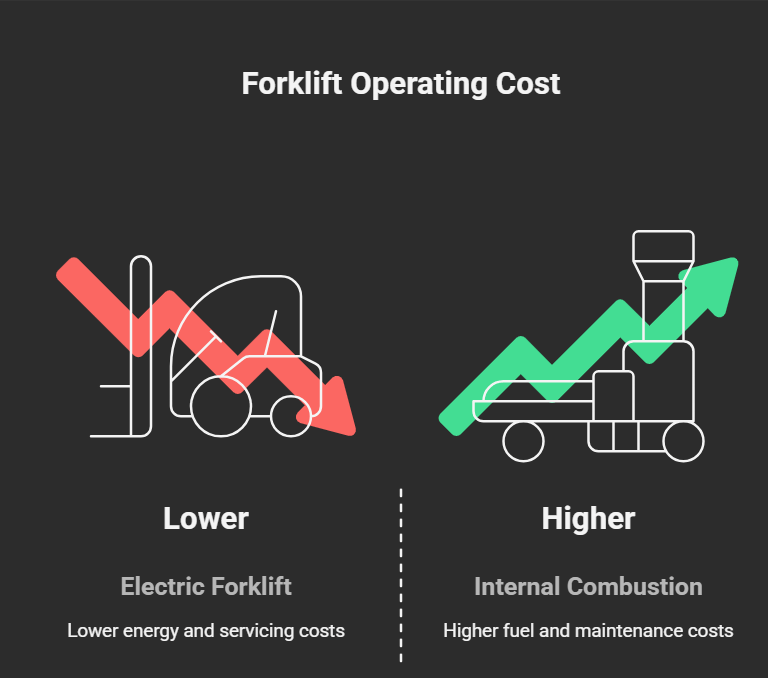
Moreover, electric forklifts are easier and less costly in terms of maintenance since they do not have the complicated parts that are normally present in combustion engines. Thus, they are becoming time-efficient over time, hence are in line with the goals of businesses that are looking to reduce their operational and environmental costs.
Additionally, some brands have transformed their factory facilities to be powered by renewable energy and have established closed-loop systems for the recycling of their waste during the manufacturing process. These actions are a clear indication of their commitment to providing industrial equipment that is less harmful to nature.
Eco-Friendly Materials and Recycling Initiatives
One of the essentials to sustainability is that the focus should not only be on the energy supply but also on the supporting elements.
Forklift producers have also made a decision to use green materials in their products. Some of the major components lighter steel alloys, plastics made from recycled materials, and biodegradable hydraulic fluids, which are becoming popular, are being utilized in this industry.
For instance, Crown Equipment Corporation can be referred to for its remanufacturing programs through which old forklifts are refurbished and resold at a lower price, thus, waste is reduced, and product lifecycles are prolonged.
While doing it, Komatsu and Mitsubishi Logisnext have launched the component recycling programs that facilitate the reuse and proper disposal of parts at the end of their lifecycles so that less waste is discharged into the dumps.
The forklift industry is making a huge move towards the adoption of circular economy principles that focus on the reuse, recycling, and energy efficiency of each stage of production. These actions not only benefit the planet but also improve brand reputation and increase customer loyalty in the era of conscious consumerism.
Choosing the Right Forklift for Your Business
The selection of the most appropriate forklift for your business can basically change the way your company works. The right model will elevate the efficiency level, reduce the chances of a breakdown, and ensure the safety of the working area.
However, making the right decision among various brands and models requires first knowing your needs and the environment you work in.
Key Factors to Consider Before Buying
Here are the most important issues that you have to think about before purchasing a forklift:
Load Capacity: Identify the heaviest load that the forklift will have to carry. Going beyond the capacity may result in the breakdown of the machine and risky situations for safety.
Lifting Height: Think about the height of the storage units or shelves. High-reach forklifts are perfect for warehouses with vertically organized storage systems.
Operating Environment: Electric forklifts are great for indoor operations as they are clean and quiet. Diesel or LPG models can be used for outdoor applications or on rugged terrains.
Fuel Type: Electric forklifts are less damaging to the environment and are more economical over a long period. Nevertheless, internally combusted forklifts provide more power for heavy-duty tasks.
Maintenance and Support: It is always a good idea to look for service centers, spare parts, and warranties before making a purchase.
Technology Integration: Most of the current forklift models are equipped with telematics and fleet management systems that allow the maximization of usage and planning of maintenance.
Watching the product at work and having a trial period to test the comfort, control, and visibility of the forklift are things that you should do before coming to a final decision. This experience gives you the assurance that your investment is in line with your operational goals.
Comparing Internal Combustion vs. Electric Forklifts
Future Trends in Forklift Manufacturing
The forklift industry is going through a digital revolution. Next-generation forklifts will not only be able to lift and move loads, but they will also be able to think, predict, and interact with their environment intelligently. Your next-generation forklifts will come with AI and IoT integration, and they will be eventually able to do most of the tasks with the least human supervision.
AI and IoT Integration
The major reasons that lead to changes in the design and operation of forklifts are Artificial Intelligence (AI) and the Internet of Things (IoT). To make them smarter, the companies are equipping them with cutting-edge sensor and data analytics modules which enable forklifts to interact instantly with warehouse management software (WMS) and other machines.
For example, predictive analytics can very early pinpoint the parts of the machine that will cause failure long before the actual breakdown thus, the expensive downtime that is avoided. AI-driven forklifts can also learn operator habits and change performance and energy consumption accordingly.
Furthermore, these smart forklifts can also transmit and coordinate their activities using a shared cloud platform, which gives a complete real-time view of operations-from utilization rates to maintenance needs- to fleet operators. This data-led approach results in smart, safe, and efficient warehouses.
Predictive Maintenance and Data Analytics
Proactive maintenance has become standard. The forklifts that are soon to be on the market will come with predictive maintenance systems powered by machine learning algorithms. These systems identify problems by looking at data from sensors—vibration, temperature, and usage patterns.
As an example, Toyota and Linde have created telematics platforms that give notifications to users when a certain part needs servicing or replacement. Besides the reduction of machine downtime caused by breakdowns, this strategy also prolongs the lifespan of the equipment.
Moreover, data analytics is enabling companies to identify bottlenecks in their workflows, optimize the productivity of their workers, and reduce energy consumption. By using AI and prediction tools, the forklift industry is preparing the ground for smart automation and high precision performance.
Conclusion: Driving the Industry Forward
The forklift industry has changed dramatically since the time of its small-scale simple machines. Those small simple machines that were once the foundation of the industry, have now turned into smart, connected, and sustainable giants that make up the entire global logistics system, thus, are able to keep it going.
To mention a few, manufacturers like Toyota Material Handling, KION Group, Jungheinrich, Hyster-Yale, and Mitsubishi Logisnext are the ones who are setting new safety, efficiency, and sustainability standards that are the main drivers of the transformation. On the other hand, innovators like Crown, Komatsu, and other emerging brands are pushing the limits of design and technology.
As long as automation, AI, and clean energy are progressing, forklifts will be even more indispensable in shaping the future of supply chains. The companies who choose to invest in modern and green forklifts today will be the ones that reap the benefits of growth and efficiency in the long run.
The next period of forklift manufacturers is full of wonderful inventions, eco-friendliness, and digitization—all aimed at one goal—moving the industry forward, one lift at a time.
TinyExcavator
Find mini excavator suppliers with reasonable prices and variety.
TYPHON Machinery Offices
2522 S Malt Ave. Commerce, CA 90040 United States
© 2025. All rights reserved.