10% Off Retail prices for our premium value mini excavators

Enhance Efficiency with Tilt Bucket Attachment
Boost your mini excavator’s performance with a tilt bucket. Achieve precise grading, better control, and faster results for any construction project.
TILT BUCKET ATTACHMENT
10/16/20256 min read
Enhance Efficiency with Tilt Bucket for Mini Excavator
Tilt bucket is an innovative attachment for mini excavators, which enhances their versatility and efficiency of operations, thereby increasing their value for money.
A tilt bucket can turn side to side, on a line with the workpiece, thus enabling the operator to accomplish precise grading, digging, and material handling tasks, while a conventional bucket is only vertically movable.
This feature is very useful especially when the space is very limited and it is necessary to have good maneuverability, e.g. in residential construction sites or landscaping projects.
Due to the tilt device, one can achieve a wider range of motion, thus making it possible to work on irregular ground or to make slopes and ditches without the aid of extra equipment. The production of tilt buckets is such that they can fit different models of mini excavators and are, therefore, user-friendly.
They generally possess a strong construction which is very often made of high-strength steel, thus giving the product the qualities of durability and resistance to wear and tear.
The design solution includes hydraulic cylinders facilitating the tilting movement and thus, the bucket's angle can be set to the desired one with great accuracy.
This versatility not only enhances the quality of the output but also shortens the time which is put in the work, hence the use of tilt buckets is indispensable to contractors and landscapers.
Key Takeaways
Tilt buckets for mini excavators are designed to provide greater flexibility and precision in digging and shaping tasks.
Using a tilt bucket can increase productivity, reduce the need for manual labor, and minimize the risk of damage to surrounding structures or landscapes.
To maximize efficiency when using a tilt bucket, operators should be trained in proper techniques and understand the capabilities of the equipment.
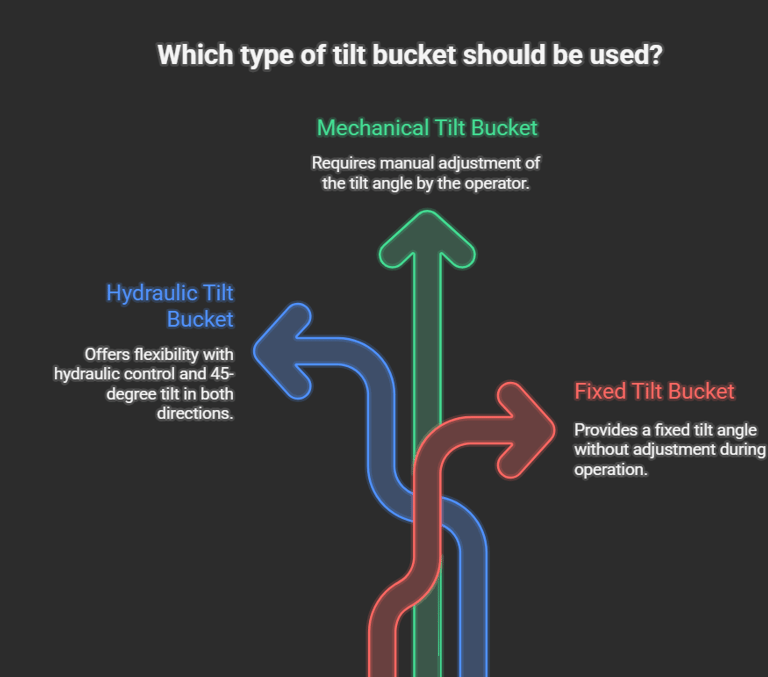
There are various types of tilt buckets available for mini excavators, including hydraulic and mechanical options, each with its own advantages and limitations.
Regular maintenance and care for tilt buckets, including cleaning, lubrication, and inspection, are essential for ensuring optimal performance and longevity.
Benefits of Using a Tilt Bucket
One of the major benefits of a tilt bucket is the efficiency whose impact can be widely felt in most of the excavation works done.
The feature of tilting the bucket empowers one to make a performance like grading and leveling, thus cutting the frequent repositioning of the entire machine. To be more specific, this advantage manifests itself when one is working on slopes or areas with uneven ground because at such times conventional buckets are scarcely able to get the right angle.
Because of the fewer repositioning instances, operators can do their works faster and thus the time saved is a labor cost too.
What is more, a tilt bucket is a contributing factor to the precision of the excavation job that is being carried out. In fact, the angle can be changed by the operator of the bucket to achieve accurate drafts and the contours, which are very important in the likes of drainage installation or landscaping.
For example, when manufacturing trench for drainage pipes, a tilt bucket is capable of helping in making the trench have the right slope for water to flow easily. Such work precision not only leads to the quality improvement of the work carried out but also makes the probability of the costly-error-in-the-form-of-rework to be lowered.
How to Use a Tilt Bucket for Maximum Efficiency
First of all, operators using a tilt bucket for maximum efficiency should Get to know different machines. In detail, it is essential to understand the implementation of hydraulic controls that are in charge of the tilting function in order to obtain accurate and fluent movements.
Come into action, operators work the hydraulic controls that enable the tilt maneuver and thus ought to be able to produce subtle and accurate movements.
Operators should exercise different tilt positions while keeping the control of the excavator so that they can grasp the way the attachment works with different terrains. The other important point about using a tilt bucket is the arranging work before getting into it. Operators need to evaluate the site and figure out the most effective ways to achieve the objectives.
For instance, when one has to grade a vast area, it could be good to start from one end and work your way across the site using the tilt to regulate the bucket if necessary. Besides, the right approach of work not only leads to the smooth running of tasks but also helps in keeping the qualitative standard throughout the project.
Types of Tilt Buckets Available for Mini Excavators
Tilt bucket sizes and shapes vary, and their designs are made to suit different models of mini excavators and their respective applications.
Normal tilt buckets are built for general usage and thus are capable of handling a wide range of works, e.g., grading, digging, and material handling.
These buckets are generally constructed with strong and heavy-duty features as well as with long-life extensions achieved through the reinforced edges.
There are also some designed to serve only specific purposes. For example, some manufacturers provide the narrow ones that are solely for precision works or cramped area works Ex.j trenching or landscaping in confined areas.
Such narrow ones allow the user to have better freedom of movement and the same time enable the operation to be done efficiently through the tilting feature.
Besides this, heavy-duty ones are available that can handle tough and demanding jobs like the demolition of the heavy-duty part of a building or the hard digging work and have their structures reinforced and big hydraulic cylinders to be able to deal with an increased load.
Maintenance and Care for Tilt Buckets
Good upkeep plays a very important role in the life, as well as the productivity, of a tilt bucket. It is a practice that should accompany every use, to always check for scenarios of wear and tearing or possible damage, mostly in places like the joints and the hydraulic parts. The operators should watch out for leaks in the hoses and also be sure that everything is tight.
In case there are worn-out parts in the edges of the bucket, it is better that a solution be proposed for their replacing so as to stop further damage.
At the same time, there is another important task involved in the upkeep of a tilt bucket, and that is lubrication.
The joints and hydraulic cylinders should be lubricated regularly in order to have smooth work, no rust, or corrosion at these places. Operators are required to go by the manufacturer's instructions for lubrication, both in terms of intervals and types of lubricants.
Besides, doing it after usage, cleaning the bucket can be of great help in ridding the bucket of the things that are building up and thus can lower its performance in the long run.
Safety Considerations When Using a Tilt Bucket
Along with being efficient and fast, safety should be a concern when using any heavy equipment, and mini excavators fitted with tilt buckets are not an exception.
The operators should be always protected with proper PPE like hard hats, gloves, and steel-toed boots. A thorough inspection of both the excavator and the tilt bucket should be done to check if everything is in good working condition, this should be done before the start of the work.
While working with a tilt bucket, an operator must think of his environment, and also keep the other workers informed.
Turning the bucket can make some areas invisible, so talking with the team members and using the spotters are very important to make sure everyone is safe. Also, the operators should not overly stuff the bucket that is beyond the bucket's rated capacity, as this could result in instability and thus accidents might happen.
Efficiency Gains with Tilt Bucket: The Case Studies
The implementations of tilt buckets on mini excavators, as well as subsequent efficiency gains, are vividly documented through concerted case studies across multitudinous sectors of industry.
The most conspicuous instance would be the employment of a tilt bucket by a landscaping company on an extensive residential project which included a lot of grading and drainage installation.
By simply doing the job with the help of the tilt bucket instead of the usual ones, they could bring down the duration of the entire undertaking close to 30% in absolute terms.
They could go fast in their work because they weren't interrupted by the necessity to frequently reposition themselves for doing the drainage job thus the whole workflow was streamlined. Another case study is throwing light on a construction company involved in a commercial site project.
To make and lay utility lines in the ground, they had to dig trenches. The firm, Innovation in Construction Ltd was able to cut the hours spent on trenching jobs by 25% thanks to the use of tilt buckets in their operations.
Refined accuracy from using the tilt function was instrumental in lessening mistakes related to slopes and depths that, in turn, led to saving costs and strengthening project timelines.
Maximize Efficiency with Tilt Buckets
Tilt buckets are a breakthrough in excavating technology, as they give mini excavator operators more versatility and efficiency in their work.
In brief, the operator's productivity level will skyrocket if they know how to properly utilize such an attachment, and, at the same time, keep it in good condition.
Convenience-wise, the use of tilt buckets is way beyond that – it actually leads to higher quality of work, as well as shorter project durations, leaving which is a great benefit to modern construction and landscaping practices.
When industries are going through changes just as they do now, it won't be long before tools like tilt buckets become indispensable assets to companies that want to stay competitive and meet their clients' requirements promptly.
TinyExcavator
Find mini excavator suppliers with reasonable prices and variety.
TYPHON Machinery Offices
2522 S Malt Ave. Commerce, CA 90040 United States
© 2025. All rights reserved.