10% Off Retail prices for our premium value mini excavators

Best Equipment for Trenching and Drainage Projects
Discover the best trenching equipment for your next drainage project. Learn how mini excavators and trenchers deliver precise, reliable, and profitable results.
4/22/20265 min read
Water is the silent destroyer of property and infrastructure. When you tackle a drainage project, you are building the primary defense system that protects foundations, roadways, and landscapes from severe water damage. Executing these critical projects requires absolute precision. If your crew digs an uneven trench or struggles with the wrong machinery, laying pipe becomes a nightmare, and the entire drainage system eventually fails.
We understand that your professional reputation relies entirely on delivering flawless, lasting results to your clients. Providing your team with the correct trenching equipment completely transforms your daily workflow. Using the right machinery ensures you hit exact depth requirements, maintain clean trench walls, and complete the job efficiently.
In this comprehensive guide, we will explore the essential machinery required for professional trenching and drainage installations. You will learn the specific roles of mini excavators and dedicated trenchers, discover how to match machines to your specific soil conditions, and see exactly how the right tools maximize your project profitability.
The Foundation of Proper Water Management
Every successful drainage system begins with a perfectly excavated trench. Whether you are installing French drains in a residential backyard or laying massive concrete culverts for municipal stormwater, the trench dictates the success of the pipe. You must maintain a precise, continuous slope to ensure gravity pulls the water safely away from the property.
Achieving this perfect grade manually with shovels wastes valuable labor hours and introduces massive human error. Heavy construction machinery completely eliminates this guesswork. High-quality trenching equipment gives your operators the mechanical control needed to carve exact lines through compacted earth.
When you invest in the right machinery, you show a profound commitment to your clients. You guarantee that their property remains protected from flooding and structural settling. Let us break down the specific machines that form the backbone of a highly capable trenching fleet.
Essential Trenching Equipment for Every Contractor
No single machine perfectly handles every excavation scenario. True operational efficiency requires matching the tool directly to the specific demands of the project. A professional fleet utilizes a mix of highly versatile machines and specialized, purpose-built equipment.
Mini Excavators: The Versatile Workhorse
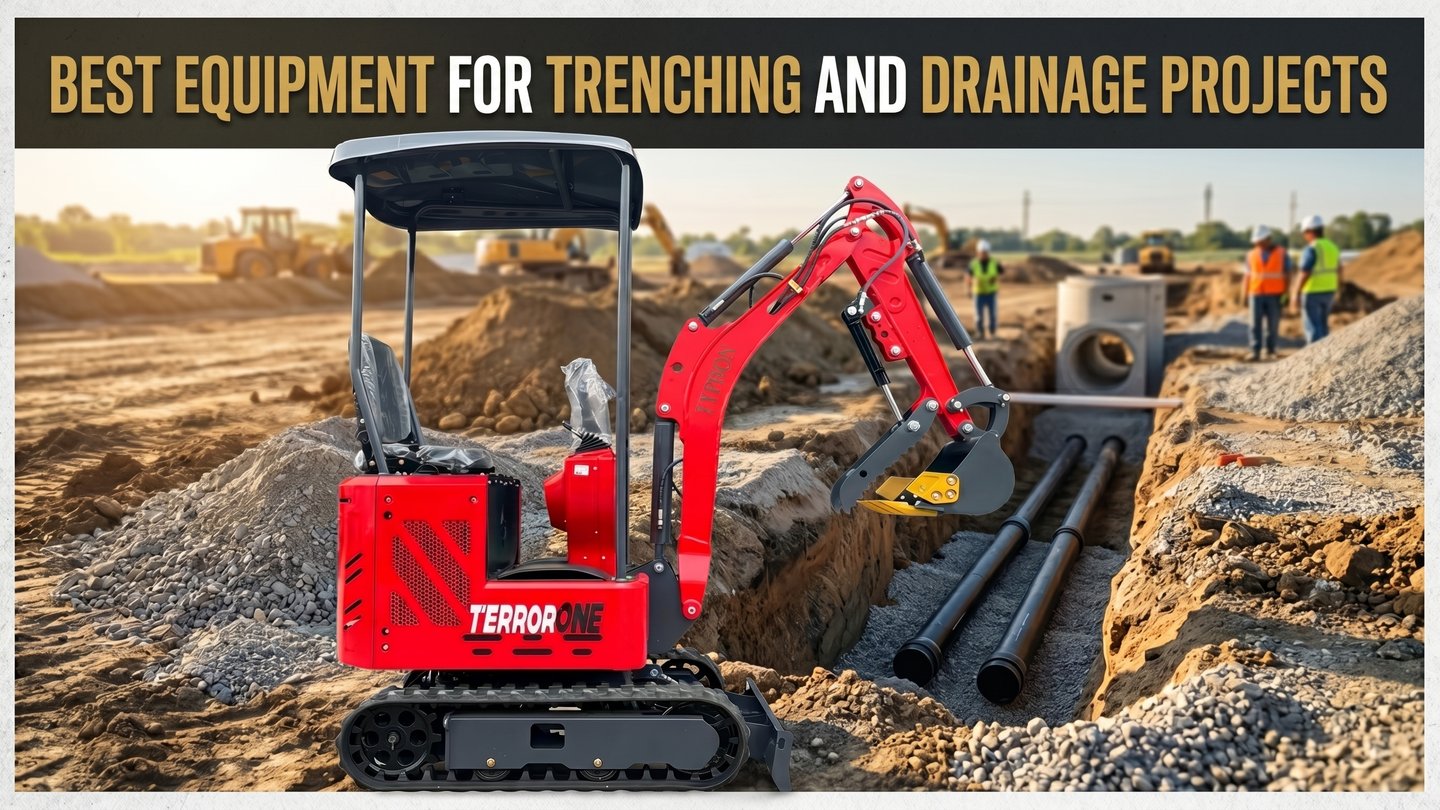
Mini excavators represent the absolute workhorses of the modern utility and drainage industry. These compact, tracked machines offer an unmatched blend of lifting power, digging depth, and job site maneuverability. When you need to dig a trench for a residential French drain, a mini excavator is often the first machine you unload from the trailer.
The primary benefit of a mini excavator lies in its extreme versatility. Operators can quickly swap out a standard digging bucket for a narrow trenching bucket. This allows your crew to dig a tight, twelve-inch-wide trench that perfectly fits a standard corrugated drainage pipe. Because you only move the exact amount of dirt required, you drastically reduce your backfilling time and save money on imported gravel.
Furthermore, mini excavators offer a 360-degree swing radius. The operator can dig the trench, swing the boom to the side, and carefully pile the excavated dirt directly next to the cut. This capability proves essential when working closely alongside building foundations or navigating around existing landscaping.
Dedicated Trenchers: Unmatched Speed and Precision
While excavators offer great versatility, dedicated trenchers provide pure, unmatched digging speed. If your contract requires installing hundreds of feet of shallow irrigation lines or electrical conduit, using an excavator will slow you down. You need a machine built exclusively for slicing straight lines through the earth.
Walk-behind trenchers work perfectly for tight residential spaces and shallow utility lines. They utilize a heavy-duty digging chain, similar to a massive chainsaw, to aggressively chew through the topsoil. The machine simultaneously excavates the dirt and pushes it neatly to one side of the trench using a specialized auger. This leaves a perfectly clean, continuous pile of dirt that is incredibly easy to push back into the hole once the pipe is laid.
For larger commercial drainage projects, ride-on trenchers deliver massive horsepower. These heavy machines effortlessly cut through densely compacted clay, rocky soils, and thick root systems. By utilizing dedicated trenching equipment, you cut your excavation time in half, allowing your crew to focus entirely on laying the pipe and securing the drainage system.
Equipment with Trenching Attachments
Purchasing a dedicated ride-on trencher requires a significant capital investment. If trenching only represents a small portion of your overall business, buying a single-purpose machine might not make financial sense. In these situations, skid steer loaders equipped with specialized attachments offer a highly reliable alternative.
You can easily mount a hydraulic trencher attachment directly to the front of your existing skid steer or compact track loader. The machine’s auxiliary hydraulic system powers the digging chain, transforming your material handler into capable trenching equipment.
Once your crew finishes cutting the trench and laying the drainage pipe, you simply drop the trencher attachment and hook up a standard bucket. The operator then uses the exact same machine to quickly backfill the trench and grade the final soil. This strategy maximizes the utilization rate of your existing fleet and heavily protects your working capital.
Selecting the Right Equipment for Your Site
Having access to top-tier machinery means nothing if you deploy the wrong tool for your specific environment. Site evaluation is a critical step in project planning. You must analyze the physical constraints of your job site before you ever dispatch a machine.
Evaluating Soil Conditions and Terrain
The earth you dig through dictates the type of cutting teeth and horsepower you need. Soft, loamy topsoil offers very little resistance. A standard walk-behind trencher or a lightweight mini excavator will easily slice through this material without straining the engine.
However, if you operate in regions known for solid limestone, heavy shale, or deeply frozen ground, standard chains will instantly snap. For extreme environments, you must deploy heavy-duty wheel trenchers or excavators equipped with hydraulic rock breakers. Analyzing your soil conditions in advance prevents catastrophic equipment failures and keeps your project moving smoothly.
Navigating Spatial Constraints
Urban environments and residential neighborhoods severely restrict your operational footprint. You cannot bring a massive, 15-ton excavator into a small backyard to fix a flooded basement. You will destroy the client's driveway, crush their fencing, and damage existing underground utilities.
For confined spaces, you must rely on micro-trenchers and zero-tail-swing mini excavators. A zero-tail-swing machine ensures that the rear counterweight never extends past the width of the tracks when the cab rotates. This feature eliminates the risk of the operator accidentally swinging the machine into a client's home or a nearby retaining wall.
The Financial Benefits of Using the Right Tools
Approaching a complex drainage project with underpowered or incorrect machinery directly hurts your bottom line. When equipment struggles to perform, cycle times increase dramatically. Your crew spends more hours on the site, driving up your labor costs and delaying your next scheduled contract.
Investing in high-quality trenching equipment completely reverses this dynamic. Fast, precise digging means faster pipe installations. Clean trench walls prevent cave-ins, eliminating the need to stop work and repeatedly clear the trench by hand.
When you equip your team with reliable machinery, you boost their daily morale and their overall productivity. You finish projects ahead of schedule, completely satisfying your clients and securing highly profitable referrals for future business.
Conclusion
Securing the long-term integrity of any property requires highly effective water management and drainage systems. Building these systems demands exact precision, unwavering reliability, and the commitment to doing the job perfectly the first time. The machinery you choose directly dictates the quality of your final product.
From the incredible versatility of zero tail-swing mini excavators to the relentless speed of dedicated chain trenchers, the right machinery guarantees your success. Evaluate your upcoming contracts closely, assess your local soil conditions, and ensure your fleet features the exact trenching equipment required to execute the work flawlessly. Take action today by reviewing your current equipment inventory and partner with a trusted equipment dealer to secure the powerful, reliable tools your hard-working crew deserves.
TinyExcavator
Find mini excavator suppliers with reasonable prices and variety.
TYPHON Machinery Offices
2522 S Malt Ave. Commerce, CA 90040 United States
© 2025. All rights reserved.